Thursday, November 14, 2013
Mariam Abdelmalak's Blog: Curriculum of Power Over
Mariam Abdelmalak's Blog: Curriculum of Power Over: Through my life journey, from my childhood to adulthood, I have constantly struggled with hierarchical relationships ...

Curriculum of Power Over
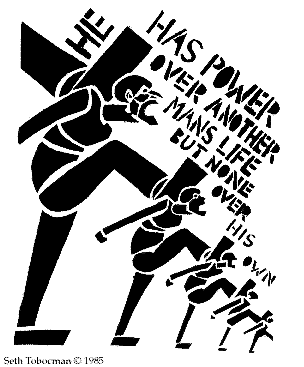
Through my life journey, from
my childhood to adulthood, I have constantly struggled with hierarchical
relationships in the Egyptian society. People have power over other people. At
home, my father has power over me, my mother, my sisters, and my brother, and
my brother has power over me and my sisters, and my older sisters have power
over me because I am the youngest one. At my schools, from elementary school to high school, teachers
have power over me and over other students in the class, and the school
administration has power over my teachers. At my college, professors have power
over me and other students. I learned that there is always a group has power
over a group- a group rules, controls and exploits other. I learned the world
is hierarchical, and I must learn my place in the hierarchy because there is no
alternative to either controlling or being controlled. This paper outlines my
story with “power over” relations that shaped my present.
Once I entered school, I found
the same hierarchical relations; I found hierarchical relations between me and
my childhood teachers. I remember my fifth and sixth-grade science teacher, Mr.
Ahmed: a short man with a thick, black mustache. Mr. Ahmed was surly; I am not
sure if he can smile and laughs like us. Mr. Ahmed also spanked his students. When
we were disobedient, we had to submit to several whacks with a stick on our
hands. Each student expected to undergo this whacks at some point in the school
year. I remember my fear of Mr. Ahmed’s class- fear not of the physical pain
but, as Kreisberg (1992) describes it, the pain of “the humiliation and
submission I would be forced to experience” (p. 4). In Mr. Ahmed’s class, there
was no doubt that he had a complete control in the classroom and had the right
to govern alone, to teach from his point of view, to discipline and punish, and
to evaluate students.
Mr. Ahmed’s classroom was
designed in a way gave him power over students; that is, his chair was placed
in a special spot of power, at the front of the room near the blackboard and
behind a wood desk while students’ chairs set in rows facing the teacher’s
desk. This classroom design is what Shor (1996) describes, “Like plants growing
toward sunlight, students are expected to sit in rows facing the lecturing
teacher at the front, the unilateral authority who tells them what things mean,
what to do, and how to become people who fit into society as it is” (p. 11). This classroom design helped Mr. Ahmed
assert his power to deliver a one-way curriculum dominated with his talk. Mr. Ahmed was talking all the class
time; it seems that, as Freire (2000) puts it, our minds were empty containers
and he was a depositor who was busy filling them with his narratives.
I also remember my English
teacher in my high school, Mr. Mansour.
I remember his insisting that we memorize verb tenses and requiring to
us to write sentences explain past time, present time and future time using the
same verb. I remember his frightening voice and his obvious pleasure at
students for not knowing the correct answers. He used the pressure to enforce
his rules and impose his expectation. Mr. Mansour’s curriculum was designed in
a way that moves toward directing the students, instead of engaging them, in a
way that depends on what he thinks “best” for the students. This one-way curriculum silenced me. It
sent me a message that I am inferior to the teacher who possesses knowledge;
therefore, he can do education for me as he sees it. As a result, I have not a
say in what I learn; I have not the right to decide what I need to learn or how
I might do it. Thus, as Taliaferro-Baszile (2010) describes it, my teachers’
inner eyes became my inner eyes and “yet these distort and refract much like a
funhouse mirror” (p. 489).
At the college I graduated from, professors' power over students was more obvious than school
teachers' power. I remember Dr. Yousef insisting that students raise their hands
whenever they want to speak and wait until he decides who should speak and in what
order. I remember when one of my colleagues spoke without getting his
permission to talk; Dr. Yousef was so angry that this student interrupted him
and he asked the student to leave the class and meet him in his office after
the lecture. Dr. Yousef was the only one who can decide what and how students
should learn; as a result, the curriculum was fixed and ready-made reflects his
view, not the views of me and other students in the class. I was never asked to
relate my personal experiences, interests, needs, speech, and perceptions to
the course of study. I do not remember that he asked me or other students about
what we already know about the topic, what we know independently of the
classroom, or how we think in the context of our daily lives.
It seems that what I study at
the college and my personal experiences are in different directions and they
never meet. Ignoring my experiences conveys to me
the insignificance of my voice. Therefore, I felt that the curriculum was
something out there did not belong to me; as a result, I found a hard time
understanding what I was being taught. That is, as Slattery (2006) explains,
“in order to understand knowledge, I must experience intimacy. The knower cannot
be separated from the known, and meaning cannot be separated from the context
that gives rise to the meaningful experience” (p. 295). Therefore, I was always wondering “Why
do I learn this?” “Why am I doing this?” or “What is the benefit of studying
this?” I could not realize the importance and the benefits of what I study
because there is no clear relationship between what I study in the classroom
and my world outside the classroom.
Although my struggle with
power over relationships within Egyptian schools and college, I find that I
treat my college-level students with the same power over relations, as my
teachers treated me. From my previous experiences with teacher treatment to
his/her students, I came to believe that “the teacher”, the “knower”, should
have power in the classroom in order to be able to control students and
maintain the discipline in the classroom. As a result, I intent to have complete power in my
classroom. I am the one who decides
the content students learn in the course, who determines assignments and tests through
which the material will be mastered, who grades the students, who controls and
regulates the flow of communication, deciding who gets the opportunity to
speak, when, and for how long, and who decides the classroom rules. Overall, I
am the one who makes all (or even most) of the important decisions about
learning for students, and students have not the rights to discuss these
decisions with me. For example, as
soon as I enter the classroom, I close the classroom door and do not permit any
late student to attend the lecture. Students should raise their hand if they
want to speak and wait until I call on them. I do not allow students to discuss
any issue or concern outside the topic that I want to lecture about. Students
are not permitted under any condition to call me by my first name even if they
are older than me.
My treatment to my
college-level students is a result of years of hierarchical relationships I
live in and with to the degree that they become part of my identity. Grumet
(1989) argues, “What we know becomes incorporated into our identities. It is
connected to what we can do and who we are” (p. 14). Also, Pinar (1975) argues,
“The present … becomes an acting out of the past, the superimposition of past
issues and situations and persons onto the present” (p. 22). From my childhood
and adulthood experiences, I grew to believe that the world is hierarchical and
I have to find out my place in the hierarchy, to control or being controlled;
therefore, I chose to control. As a result, I taught and treated my student by
the same way I was taught and treated when I was a student because I did not
another way. Grumet (1989) argues, “Knowledge is a symbol for our experience in
the world. What we know is connected to what we can do” (p. 16).
These relationships of power,
where school teachers and college professors have power over their students,
are not unsystematically and randomly developed. Rather, they reflect
predominant norms, values, and beliefs of a society (Kreisberg, 1992). Noddings
(2009) argues, “Educational aims always reflect the aims-explicit or implicit-
of the political society in which they are developed” (p. 434). Also, Shor
(1996) emphasizes that these power problems “are social and historical, not
personal peculiarities; that is, they already exist in class before the
teacher’s introduction of the syllabus, before the presentation of formal
academic subject matter, before the teacher utters a signal word, because
education is a social activity formed within the cultural conflicts in society
at large” (p. 17). Thus, the Egyptian teacher power over students reflects
values and beliefs exist in the Egyptian society- a society that has suffered
many years of colonization. Being a colonized country for many years, Egypt and
its people are shaped by and reflect legacies of colonization. Asher (2010)
argues, “While not all of us may have experienced colonialism/imperialist expansion,
I argue that we all implicated in and affected by its effect-the fact of
colonization” (p. 396). That is, “colonization – the physical and psychic
occupation and control of a people, a place, a person- happens at the
individual and systemic levels and that the colonized internalize the
colonizer” (p. 395). Thus, Egypt is affected by the colonization, and its
people, including myself, and its institutions internalize the colonized structure,
where some have power over other.
This was my story with power over relationships, with my school teachers and then with my college teachers, which affected
my present relationship with my students. Conceptualizing my past and my
present enables me to envision new possibilities to democratic teacher-student
relationships, possibilities to mutual authority between teacher and students
where students decide aspects of their learning, and possibilities to learning,
not knowledge transfer, occurs in a dialogic form. In particular,
conceptualizing my past, my present, and my future enables me to see the
possibility and necessity to change my relationship with my students; that is
as Todd (2003) argues, “our commitment to our students involves our capacity to
be altered” (as cited in Springgay & Freedman, 2010, p. 237).
I dream of democratic teacher-student relationships where both teacher and students learn from each other. Freire (2000) argues, “Education must begin with the solution of the teacher-student contradiction, by reconciling the poles of the contradiction so that both are simultaneously teachers and students” (p. 72). To resolve the teacher-student contradiction, the relationship between teacher and students should be a horizontal relationship-“A with B” relation- fed by love, humility, hope, faith and trust, instead of a vertical relationship- “A over B” relation- which “lacks love, is therefore acritical, and cannot create a critical attitude” (Freire, 1973, p. 46). That is, although the fact that the teacher clearly has knowledge that the students do not have, students also have knowledge that the teacher does not have- knowledge about their everyday lives. Therefore, in teaching the students, the teacher necessarily must reconstruct his/her own knowledge and thus join the students in the act of learning. Therefore, a teacher should accept that s/he does not know everything, and students should recognize that they are not ignorant of everything.
Thursday, October 17, 2013
A Practice for Building Online Learning Communities

In the following,
I discuss the processes I use in one of my online course (EDUC 518) in order to
build online learning communities. EDUC 518, Technology and Pedagogy, is a fully online course in an Educational Learning Technologies’
master’s program at a medium-sized university in the U.S. Southwest.
Building Community From the First Day
of the Class
In
my online course, I provide activities that assist students to connect with
peers and to build relationships from the beginning of the course. The first
assignment asks students to introduce themselves to their classmates with the
purpose of helping students find others with whom they can build a
collaborative relationship. I find
that the introductory activity is quite successful in assisting students to
develop collegial relationships and to help them to get to know each other
early on in the course. The introductory activity effectively enables students
to locate compatible colleagues with similar interests to support further
collaborative work on assignments and projects. In my online courses, the
introductory activity does not require anything more than the ability to
express knowledge of self. In the introductory activity, I ask students to
provide information about 1) something personal (married, kids, hometown,
hobbies, etc.), 2) something about their professional and educational
background, and 3) favorite video, favorite song, favorite spoken piece,
favorite website, and/or favorite photo/image; thus expanding the range of
personal information to be shared with the class. Students are also required to
respond to each other.
Using Web
2.0 Technologies
I extensively use Web 2.0
tools in my online course to foster students’ sense of community. In the first
unit, I ask students to create a Skype account, a Gmail account, and a Twitter
account and send me a message using these tools. The purpose is to help
students be familiar with these tools before they actually use them during the
semester. In the next unit, I use Twitter to facilitate class discussion. I ask
students to read about the week’s topic, and then tweet about what they learned
from that week’s reading assignment using the course hashtag #EDUC518. Students
are also required to reply to at least two other students’ tweets.
Additionally,
students are required to create blogs through Blogger and engage in
conversations through these blogs. The students are to blog in reaction to a
prompt. Then they are required to read and comment on each other’s blogs. The
course assigns five blogs. Rubrics are used to grade students’ blogs and grade
their feedback to each other. In another unit, students are asked to
collaborate using Skype and Google Doc to create a lesson plan. Besides, at the
beginning of each unit, I use Screencast-o-matic to give students an overview
of the unit and to increase students’ sense of belonging in the course. I find
that using Web 2.0 technologies help connect students through these various forms of
communication. Particularly, the use of blogs and Twitter helped to build a
learning community through dialogue and conversation among students.
Using Threaded Discussions
Threaded
discussions are used to encourage students’ sense of community. The course uses Canvas’s threaded discussion feature to conduct
asynchronous discussions. There are three discussion forums in the course. In
each discussion forum, I post three questions, each as a separate thread.
Students are expected to respond to each of the three threads and then react to
the responses of a minimum of two peers. By replying to each other’s
posts, students have the opportunity to work collaboratively with each other to
expand and deepen their learning experience, test out new ideas by sharing them
with their classmates, and receive critical and constructive feedback. Students
are also required to include references and citations to relevant articles that
support their argument. The discussion activities have clear
instructions about how much time is involved in participation in the
discussion. The discussions are graded using a rubric that assigns points
according to the level of engagement.
Additionally,
there is an ungraded discussion, titled “Get or Give Help Here”, where students
are encouraged to post any questions they may have and to help each other. This
discussion area became a gathering place where students could engage with each
other outside of the regular or required discussion assignments. The focus here
is to provide a safe place for students to connect without having to feel like
they are being evaluated.
Pairing Students in Activities
Once
students have gotten to know one another on a social level through the
introductory activity, Canvas’s threaded
discussions, and blog discussions, peer partnership activities are utilized. The
purpose of pairing learners for an activity is to help them to develop a sense
of community and to prepare them for team activities. Around the midterm, I
design a Dyad activity in which students are asked to find a partner to work
together. In
the Dyad activity, students are asked to work with a partner of their choice to
investigate a specific topic and use the results of their interaction to
prepare a joint posting to the discussion board. Two weeks
before the Dyad activity starts, students are asked to select their partners in
order to give them enough time so that the selection process can occur. Student
evaluation in the Dyad activity is based on: 1) the quality of the discussion which
is assessed using a discussion rubric, 2) peer evaluation using a rubric, and 3) reply to at least 2 other students' posts.
Encouraging Collaborative Activities
After
a peer partnership activity has been completed, students are asked to create
their own collaborative groups. The students who worked on the Dyad activity have
the freedom to combine their small groups into larger teams for collaborative
activities or to create new groups. Students are asked to create their groups two
weeks before the collaborative activity will start in order to give students
enough time so that the selection process can occur. Additionally, before
working in the collaborative activity, students are provided with a written explanation
of the importance of the collaborative work as well as instructions for
completing it. Students are also given guidance to establish
group polices and procedures and suggestions of collaborative technology tools that
can be used (See Figure 4). Before working in the
group activity, the students are asked to use a group contact template
suggested by Conrad and Donaldson (2004). This document suggests
that the group members specify the primary method of and frequency of
communication, make contingency plans for emergencies, and decide whether or
not to select a group leader. The contract allows group members to create a
group management plan for the semester’s activities. Additionally, before
working in the collaborative activity, students are asked to participate in a
practice exercise for group development. With this class, a graded activity,
titled The Critical Insight Activity, is used. The purpose is to help students
to practice their group polices and procedures and to practice collaborative
technology tools. Student grading in the collaborative activity is based on: 1)
the quality of the content that is graded using a rubric and 2) peer evaluation
in which students are asked to assess each other’s performance on the team
using a rubric.
During
the group work, I offer suggestions throughout the creation process, act as a
mediator when needed in various groups throughout the semester, and have the final
word when problems arose. The contracts were effective in that all groups
completed a product or project according to the specifications given in the
syllabus. Groups typically handled their problems according to their contracts
before asking me for help in this area. Most groups
followed the contracts they created without
difficulty, but when difficulties arose that the group could not handle, the
members sought help from me. The group
contracts helped to build a subset of the community (small groups) within the
larger community (the class). In addition, the contracts helped to facilitate
group interaction and cohesion by subtly forcing group members to look at the
various personalities, skills, and workloads involved in their group.
Conclusion
The literature provides evidence that students’
sense of community is critical to student success in online
environments. Thus, building
and sustaining strong learning communities should be an essential dynamic in
virtual classrooms. We
educators should intentionally work to build and foster learning communities
among students in online courses. A review of the literature suggests that
instructors teaching at a distance may promote sense of community by 1)
building a learning community from the first day of the class, 2) using Web 2.0
technologies 3) using threaded discussions, 4) pairing students in activities
before collaborative work, and 5) encouraging collaborative activities. In my
online course, I intentionally draw on these processes in order to build
learning communities among my students. I need to continue to evaluate and
revise these processes in order to effectively build and sustain learning
communities in my online courses. Yet, building online learning communities is
a difficult task. However, doing so is an integral step for improving learning
and teaching in online environments, and thus work in this area should
continue.
Mariam Abdelmalak's Blog: The Process of Building Learning Communities in an...
Mariam Abdelmalak's Blog: The Process of Building Learning Communities in an...: Online courses are different than face-to-face courses at many aspects. As we can see in this image, in the face to face class, the...
The Process of Building Learning Communities in an Online Course
Online courses are different than face-to-face courses at many aspects. As we can see in this image, in the face to face class, the learner is present and the instructor can read the body language, make eye contact, identify students’ expressions– read the visual cues. the instructor can recognize when learners are bored, lost focus.

This is not so easy to do online. Students in online classes work at computers miles apart at varying times of the day, resulting in a feeling of isolation.

Community building is widely
accepted as a sense rather than a tangible entity (Wiesenfeld, 1996). Sense of
community has been defined as “a sense that members have a belonging, members matter
to one another and to the group and a shared faith that member's needs will be
met through their commitment to be together” (McMillan & Chavis, 1986, p.
9). The literature highlights many strategies and processes to help online
students build a sense of community. The following section reviews the
literature that puts the foundation for the processes I use in my online course
to build a sense of community among students.
In order to help
students to develop a sense of community, we educators need to develop
authentic and effective ways to assist them to connect with peers and to build
relationships from the beginning of the online course. It has been argued
(Dixon, Crooks & Henry, 2006; Palloff & Pratt, 2005; Conrad &
Donaldson, 2004) that instructors must develop ways to create a community of
learners early on in online environments. Additionally, Palloff and Pratt
(2007) assert the necessity of establishing “human-to-human contact before the
interaction involved with the course content begins, a means by which presence
can be established (p. 12). To establish human contact between students before their
participation in the course content, the use of an introductory activity is
recommended. According to Ebersole (2003), creating discussion areas for
students to use for initial introductions is one of community building
activities that help reduce the feeling of isolation and increase social
presence from the beginning of the online course. Introductory postings provide
opportunities for students to present themselves to their classmates and begin
the interaction with one another in a nonthreatening manner (Conrad &
Donaldson, 2004).
Much of
the writing on the community-based approach to online learning—that are related
to developing and sustaining it—describes the use of asynchronous threaded
discussions in response to instructor discussion questions as the main means by
which this community is developed (Cazden, 1988; Buckingham,
2003; Palloff & Pratt, 2007; Clark & Kinne, 2012). In online learning,
these discussions have become a common feature for structuring learning
experiences through personalizing and humanizing the course (Palloff &
Pratt, 2007). Many researchers who work in online environments agree that asynchronous
discussions are places where students learn from each other (Carr-Chellman
& Duchastell, 2000), provide accessibility to each other’s thinking (Peterson
& Slotta, 2009), and enable students to participate even more than in live
classroom discussions (Hirumi & Bermudez, 1996; Paloff & Pratt, 1999;
2007). Additionally, Ebersole (2003) recommends
creating spaces for student-to-student interaction where students can engage
with each other outside of the regular or required discussion assignments.
These spaces, as Ebersole explains, contribute to an online learner’s sense of
connectedness with other students and contribute to overall level of
satisfaction with the course.
Collaborative
activity is also critical to help develop that sense of community, thus
enabling the creation of an environment in which further collaborative work can
happen (Palloff & Pratt, 2005; 2007). For helping students to work
effectively in activities that involve online collaboration and reduce
resistance to the activity, Palloff and Pratt (2005) suggest providing students
with an explanation of the importance of and reasons for including collaborative
activity in an online course. Dell (2004) also stresses the importance of
giving clear instructions and guidelines regarding not only the assignments,
but also the method and tools of communication that will be used. Dell also
suggests designing evaluation criteria to include peer evaluation. He argues
that this peer evaluation rewards extraordinary team members while at the same
time appropriately evaluates non-contributing members. Additionally, the use of
an agreement or contact among group members has been noted to be of significant
importance in promoting learner satisfaction with collaborative learning
experiences online (Murphy, Mahoney & Harvell, 2000; Doran, 2001). The contact
outlines how the group members will interact together, determines the roles
each member will play in the collaborative activity, and creates benchmarks and
deadlines for the completion and submission of collaborative work (Palloff &
Pratt, 2005). Furthermore, it is advised to pair learners for an activity as a
way to build a bridge to collaborative group work later in the course and help
learners to develop an appreciation of collaboration (Conrad
& Donaldson, 2004; Palloff & Pratt, 2005).
Web 2.0 technologies
can play an important role in the development of a learning community among
students in online courses (Kearns &Frey, 2010; Palloff & Pratt, 2009; Gunawardena
et al., 2009). Web 2.0 is the term used to describe a variety of web sites and
applications that allow anyone to create and share online information or
material they have created. A key element of the technology is that it allows people
to create, share, collaborate, and communicate. There is a number of different
types of Web 2.0 applications including wikis, blogs, and social networking. According
to Palloff and Pratt (2009), Web 2.0 technologies do have the ability to
enhance the development of community online and reduce the isolation and
distance felt by students in online courses. Palloff and Pratt argue, relying
on any tool of Web 2.0 technologies to accomplish that task is a bit
shortsighted. However, the inclusion of a variety of means by which community
is developed in an online course can only serve to facilitate this task by
increasing the means and amount of communication possible between students as
well as between students and the instructor (Palloff & Pratt).
Reference
Buckingham, S. (2003). Perspectives on the
experience of the learning community through online discussion. Journal of Distance Education, 18(2),
74-91.
Carr-Chellman, A., & Duchastel, P. (2000). The ideal online course.
British Journal of Educational
Technology, 31(3), 229–241.
Cazden, C. (1988). Classroom
discourse: The language of teaching and learning. Portsmouth, NH: Heinemann.
Clarke, L., & Kinne, L. (2012). More than words: Investigating
the format of asynchronous discussions as threaded discussions or blogs. Journal of Digital Learning in Teacher
Education, 29(1), 4-13.
Conrad, R., & Donaldson, A. (2004). Engaging the online learners: Activities and resources for creative
instruction. USA: Jossey-Bass.
Dell, D. (2004). Philosophy
of online teaching. Capella University.
Dixon, J., Crooks, H., & Henry, K. (2006). Breaking the ice:
Supporting collaboration and the development of community online. Canadian Journal of Learning and Technology,
32(2), 1-14.
Doran, C. (2001). The effective use of learning groups in online
education. New Horizons in Adult
Education, 15(2). Retrieved May 6, 2004, from http://www.nova.edu/~aed/horizons/volume15n2.html.
Ebersole, S. (2003). Online
learning communities: Connecting with success. Retrieved September 20, 2012,
from http://bcis.pacificu.edu/journal/2003/09/ebersole.php
Hiltz, S.R. (1998). Collaborative learning in asynchronous
learning networks: Building learning communities. Orlando, Florida.
Hirumi, A., & Bermudez,
A.B. (1996). Interactivity, distance education, and instructional systems design
converge on the information superhighway. Journal
of Research on Computing in Education, 29(1), 1–16.
Kearns, L., & Frey, B.
(2010, July/August). Web 2.0 technologies and back channel communication in an
online learning community. TechTrends, 54(4),
41-51.
LaPadula, M. (2003). A
comprehensive look at online student support services for distance learners. The American Journal of Distance Education, 17(2),
119–128.
McMillan, D. W., & Chavis,
D. M. (1986). Sense of community: A definition and theory. Journal of Community Psychology, 14(1), 6 – 23.
Murphy, K., Mahoney, S.,
& Harvell, T. (2000). Role of contracts in enhancing community building in
Web courses. Educational Technology &
Society, 3(3), 409-421.
Palloff, R., & Pratt, K.
(1999). Building learning communities in
cyberspace: Effective strategies for the online classroom. San Francisco: Jossey-Bass.
Palloff, R., & Pratt, K.
(2005). Collaborating online: Learning
together in community. San Francisco: Jossey-Bass.
Palloff, R., & Pratt, K.
(2007). Building online learning
communities: Effective strategies for the virtual classroom. San Francisco:
Jossey-Bass.
Peterson, S. S., & Slotta,
J. (2009). Saying yes to online learning: A first-time experience teaching an
online graduate course in literacy education. Literacy Research and Instruction, 48, 120–136.
Rovai, A. P., Wighting, M.
J., & Lucking, R. (2004). The classroom and school community inventory:
Development, refinement, and validation of a self-report measure for educational
research. Internet and Higher Education,
7, 263–280.
Sadera, W., Robertson, J.,
Song, L., & Midon, M. N. (2009). The role of community in online learning
success. Journal of Online Learning and
Teaching, 5(2), 277–284.
Walker, J., Wasserman, S., &
Wellman, B. (1994). Statistical models for social support networks. In S.
Wasserman and J. Galaskiewicz (Eds.) Advances
in Social Network Analysis. (p. 53-78) Thousand Oaks, CA: Sage.
Wellman, B., & Gulia, M.
(1999). The network basis of social support: A network is more than the sum of
its ties. In B. Wellman (Ed.). Networks
in the Global Village. (p. 83-118) Boulder, CO.: Westview Press.
Thursday, September 12, 2013
Mariam Abdelmalak's Blog: Teaching Graduate Students
Mariam Abdelmalak's Blog: Teaching Graduate Students: Educators of graduate students may need to explain the reasons for asking students to participate in an experience and expa...
Teaching Graduate Students
Educators of
graduate students may need to explain the reasons for asking students to
participate in an experience and expand their traditional role. Adult students,
as Knowles et al (2005; 1998) and Grow (1991) argue, need to be given
explanations and evidence that carrying out some activities carries benefits
for them. Grow (1991) argues that adult learners will be motivated and
encouraged when they are given clear explanations of why the experience is
important.
Educators of graduate students need to be willing to share power with students and
to be guided by their interests and needs in such a way that encourages students’ input in the course content, the format in which the material is presented, and the manner in which their performance is assessed. The shift of
content from being the instructor’s sole possession to something that is presented in response to the expressed interests and needs of students can contribute to graduate students’ engagement and ownership of learning. Educators of graduate students need to be flexible and
sensitive to respond to students’ learning needs and the direction in which the
students want to take the curriculum. However, students might not have enough
or might not have the right kind of knowledge and skills to participate in
curriculum design. Therefore, a move toward involving learners in curriculum
decision-making requires flexibility and risk-taking, and entails a strong
faith in the capacity of learners. Besides, faculty need to be willing to
suspend their own judgments over the suitability or value of students’
suggestions and ideas for classroom work, in the spirit of drawing out and
building upon the learners’ own capacity to create knowledge.
Graduate
students, after spending so many years in traditional educational settings,
have been trained to be dependent on teachers to teach them, which may make it
difficult to invite them to determine what they would want to learn. Hence, educators need to consider possible
difficulties that students may experience due to their familiarity with an
education system where teachers have dominated the classroom. We educators and
students need to challenge these habits and confront fundamental questions
about the nature of teaching and learning. We educators need to engage
in critical reflection to understand the dynamics of power in the classroom and
to uncover the hegemonies that drive our practices. We must be alert to the
presence of power in our classrooms and its potential for misuse. This may help
us to be more aware of the effects we are having on students. As Brookfield
(1995) argues, “Becoming alert to the oppressive dimensions of our practices
(many of which reflect an unquestioned acceptance of values, norms, and
practices defined for us by others) is often the first step in working more
democratically and cooperatively with students” (p. 9).
Meeting graduate students’ needs is essential. Having the opportunity to develop objectives and
topics based on their perceived needs and goals can make the course meaningful,
encourage students’ investment in the course, improve their motivation to
learn, and enhance their sense of ownership of learning. This indicates the significance of creating a space for graduate students to develop
learning objectives for themselves based on their felt needs and interests.
Involving adult students in developing learning objectives for themselves is
critical for their involvement and learning (Knowles et al., 2005; Mackeracher,
2004; Wlodkowski, 1999; DeVries & Zan, 2005; Auerbach, 1992). According to
DeVries and Zan (2005), “Adults are often capable of constructive effort even
when interest is at a low level [...] however, the absence of interest can
prevent effective effort. When our interest is thoroughly engaged, our efforts
are most productive” (p. 63).
Involving graduate students in designing course assignments can give them
a sense of control over their own learning, which can encourage them to take
responsibility for their own learning. The traditional role, in which the instructor has power to make all decisions
relating to the education of students, needs to change into a partnership. In
this partnership, students are encouraged to take some control of their
education, including some control over their own assessment. Heron (1979)
asserted that no relation of partnership between students and faculty would be
complete without the consideration of giving students some control over
assessment. Heron said, “If there is no staff/student collaboration in
assessment, then staff exert a stranglehold that inhibits the development of
collaboration with respect to all other processes” (p. 13). Therefore,
assessment needs to move to a cooperative relation in which the assessment is
“jointly owned by both staff and students” (Boud & Prosser, 1980, p. 26).
However, inviting students to have some control over assessment does not mean
that students no longer need the instructor’s help. Graduate students need some control of the assessment process, but also they
need the instructor’s intervention through the process. They need the
instructor as a facilitator who guides without telling them what to do. This
suggests the need to achieve a balance between student control and the
instructor’s facilitation in a way that does not undermine students from
assuming responsibility in the pursuit of understanding and developing new knowledge.
Combining different delivery modes with inviting graduate students to
choose their mode of participation can accommodate a face-to-face class to
students’ different needs and life situations. This in turn can enhance students’
motivation to learn, engagement, and participation in the course. This indicates the significance of flexible delivery with giving students the
opportunity to choose their mode of participation. Graduate students as adult
learners need flexible instruction that extends the boundaries of learning so
that learning can occur in the classroom, from home, and in the workplace. The
goal is to provide quality-learning experiences through a consideration of the
learners’ personal characteristics, work responsibilities, learning needs, and
personal circumstances (Espinoza & Pannell, 2002; Casey & Wilson, 2005;
Iqbal, 2011). Educators of graduate students are actively encouraged to find
effective and flexible delivery models to provide all students with more
convenient access to quality learning experiences than is possible with
traditional on campus offerings alone.
Blending multiple delivery modes with the choice of how students
can complete course activities during any given week or for any given topic can offer a way to differentiate instruction to meet students’ different learning
styles and strategies. Educators of graduate students need to consider the
learning needs of individual learners and focus on producing learning with
every learner by whatever means work best for them. This requires that
instructors of graduate students value providing participation choices to
students more than they value forcing everyone into the “best” way of learning
a set of content. Educators of graduate students are highly encouraged to find
ways to supplement traditional classroom-based classes by alternative
instructional delivery methods to provide all students with more convenient
access to quality learning experiences that match their preferences, schedules,
and professional goals.
The flexible approach toward participation can give graduate students
some control over the time and place of their participation, thus a feeling of
being more in control of their own learning approach. This suggests
that educators of graduate students need to develop courses and instructional
activities in a way that allows learners to take some control over their
learning environment. Allowing graduate students to control (or at least
influence) the pacing and specific activities in a learning environment can
improve their learning experience (Beatty, 2010) and increase their motivation
and engagement in the learning process (Wlodkowski,
1999).
Subscribe to:
Posts (Atom)